

Dupery · Practical deduction guide
Turn conflicting claims, unusual chip costs and changing clues into a repeatable investigation method. Nine lessons from office, casino and docks play.
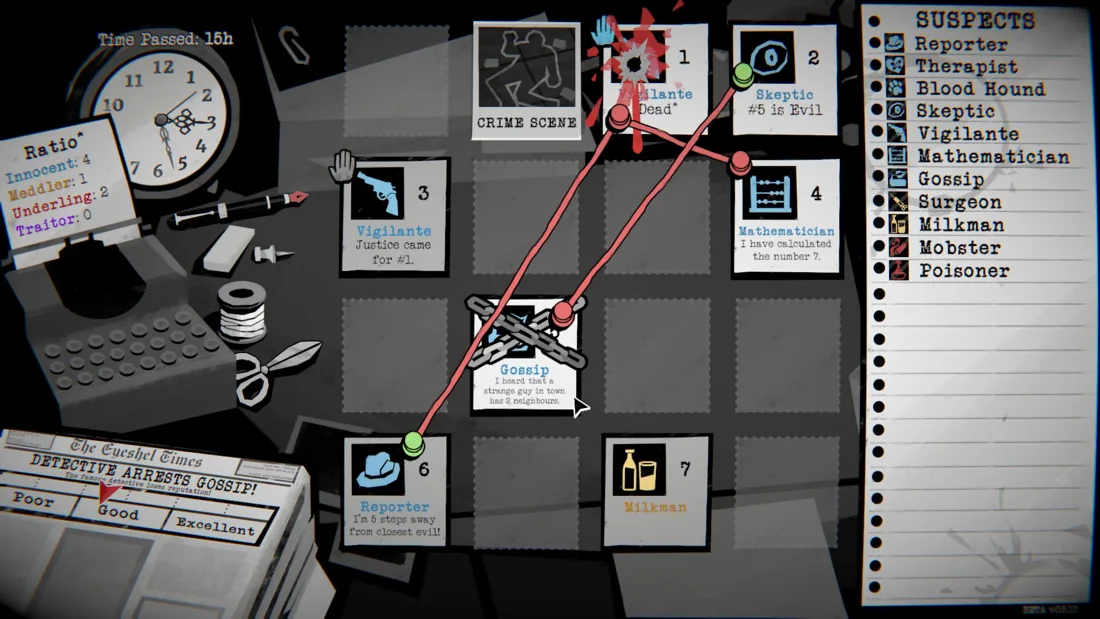
The officially analyzed playthrough covers the office tutorial and runs through T6 (P1–P7), the casino tutorial and runs through T6 (P8–P14), and the docks tutorial (P15). It stops before the regular docks campaign and final confrontation. The T6 milestones describe this recording, not the game’s maximum difficulty. Cases are procedural: use the reasoning, not the recorded addresses.
Start with the office to practise separating claims from alignment. In the casino, add a resource ledger and check paid abilities before trusting their results. At the docks, add boat position, hidden addresses and a return route to your notes. Consult the campaign guide for progression beyond the recording.
Duplicate claims are a starting point
Two people claiming the same role do not tell you which one to arrest. Mobster lies while imitating an in-play role, Conman imitates an in-play role without lying, and Copycat imitates a good in-play role. Record the claim, test its information, then check which impersonators the case permits. A truthful ability result settles that observation; it does not establish good alignment.
Reconcile the sum before accusing the witness
In the office footage, a seemingly impossible sum makes sense once Fall Guy is considered. Other roles normally read this good role as an evil Underling. For Mathematician, compare the announced total with what the checking role perceives, not just your list of true enemies. Check taint and transformations too. Only solve for a missing address after the rest of the terms are reliable.
Keep an event log, not just a suspect list
Record the hour of each investigation, bell, death and arrest. Compare Clock Maker with an observed bell; forgetting when it rang is not evidence of a lie. If Judge may be present, plan before the tenth hour and heed the gavel’s immediate-arrest requirement. Usually leave Scoundrel until the other living, unarrested evil roles are dealt with; failed arrest attempts still advance time. Read its taint exception.
Separate the investigation price from hidden costs
A normal 2-chip investigation followed by a 12-chip loss can fit a 10-chip theft by Pickpocket, once other modifiers are ruled out. Mark the four adjacent positions around that target as candidates, then compare other observations. No theft does not normally exclude a candidate: the base chance is 50%. Debt Collector instead adds 4 to abilities around it; Scam Artist adds 10 to its own ability. Arresting Pickpocket returns stolen chips; killing it does not.
Check the actual targets of an ability
Visionary reporting that three roles work together means they share an alignment, not that all three are good. Its lying or tainted response instead names one or two addresses as evil and differs from the truth. Before comparing results, check Accountant: while active, it shifts every selected target one address forward, wrapping the highest to the lowest. Keep clicked targets and actual targets separate in your notes.
Do not spend chips on an untested promise
Hot Shot can turn a card into five times its value in chips; J, Q and K count as 10. If lying or tainted, it costs that amount instead. A face card therefore risks 50 chips before other effects. Check possible taint before chasing income, especially around a slot machine created by Investor. Keep a reserve for decisive investigations and wrongful-arrest costs. A large balance is room to recover, not proof that guessing is efficient.
Reopen conclusions after alignment changes
The late casino footage shows why a truthful statement can survive an alignment change. Devil makes one good role evil; that rule does not itself say the converted role starts lying. Recruiter can also change the alignment of Meddlers. Recheck current alignment rather than reusing a previous “good” label. The absence of a new contradiction does not prove the case is finished.
Treat every voyage as an action with consequences
Before moving, reserve fuel for every leg and the return to port: each move costs 1 plus its steps. Hidden roles still have addresses; Crabber can test an empty position. Moving can update clues or trigger Pirate Captain. A mine placed by Minelayer kills adjacent neighbours and costs another 4 fuel: triggering it is not a universally safe shortcut. Return to port, deal with every Traitor and satisfy the arrest requirement before ending the case.
Let the case limits choose the next action
Treat category counts as hard limits: if an explanation needs more Underlings or taint sources than the case allows, reject it. Good alignment is not the same as the Innocent category; Bounty Hunter is a good Meddler, so category-specific abilities must use the exact category. If Hitman or Serial Killer may trigger soon, check the next trigger and investigate the target that separates the most remaining explanations. Stop opening doors once only one solution remains. Stamps and reputation shape the whole run; the eight-case objective shown in launch footage is not a universal campaign rule.
Sources & update
Official game analysis · 1.0.5 · 2026-10-17
Dupery · Steam · Gilded Rune Games · Yogscast Games · GamerSky Games